The Castillo de San Marcos is the oldest masonry fort in the continental United States, and it sits right on the waterfront of St. Augustine, the oldest continuously occupied European settlement in the country. Built by the Spanish starting in 1672, it has never been taken by military force. That record alone makes it worth a morning of your trip. This guide covers what to expect when you visit, what you’ll see inside the walls, and how to fit the Castillo into a wider St. Augustine day.
What the Castillo is and why Spain built it
Spain had controlled the Florida peninsula since the 1560s, but St. Augustine was always vulnerable. The city sat on the Atlantic coast with no serious fortifications, and by the mid-1600s, English colonies were pressing down from Carolina. Spain needed a permanent structure that could anchor the northern edge of its Florida territory.
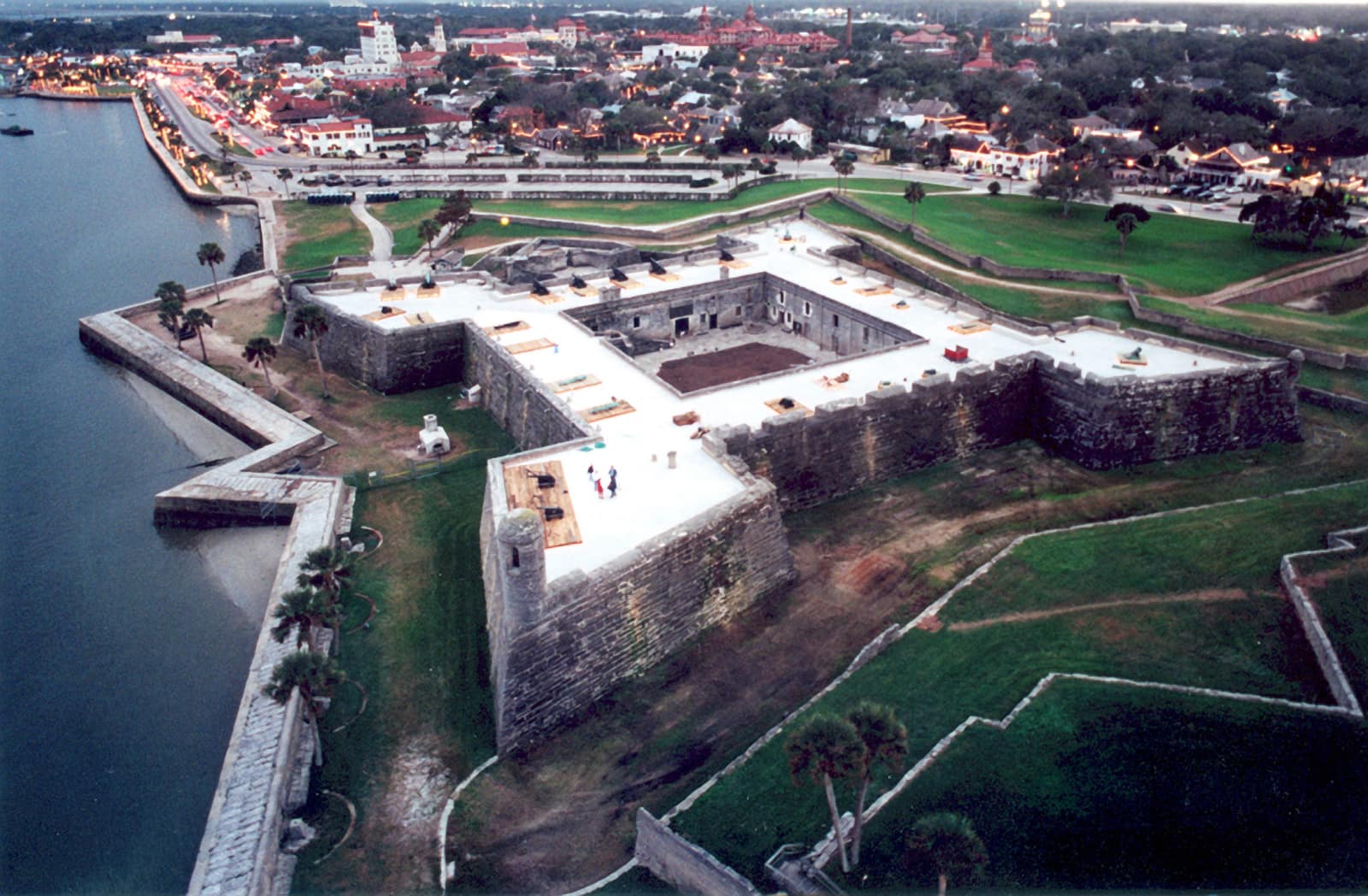
Construction on the Castillo started in September 1672 and finished in 1695. The design is a classic star-shaped bastion fort, four diamond-pointed bastions named San Agustín, San Carlos, San Pablo, and San Pedro angling out from a square central structure. The star shape was standard military engineering of the period: the points eliminated blind spots along the walls and allowed defenders to cover each section of the exterior with fire.
The material is what makes the Castillo genuinely unusual. The walls are built from coquina, a sedimentary rock formed from compressed shells and coral that the Spanish quarried from Anastasia Island, just across the Matanzas River. Coquina does not behave like stone under cannon fire. Instead of shattering and sending shrapnel through the garrison, it absorbs the impact. Cannonballs lodge in the walls rather than punching through them.
The British found this out firsthand. English forces from Carolina attacked St. Augustine in 1702 under Governor James Moore, who bombarded the Castillo for weeks before giving up. General James Oglethorpe tried again in 1740 with a larger force. The fort held both times.
Tickets, hours, and getting there
The Castillo is a unit of the National Park Service. Admission is $15 per person for visitors 16 and older, free for 15 and under. The America the Beautiful annual pass covers entry, so if you plan to visit multiple national parks or monuments in Florida or elsewhere, the $80 pass pays for itself quickly. Check the NPS site for the most current hours before you go; the fort typically opens at 9 a.m. and closes at 5 p.m. daily.
The Castillo sits at the northern edge of downtown St. Augustine on Castillo Drive, right on Matanzas Bay. From the downtown parking garages on Cordova Street and the Visitor Information Center on San Marco Avenue, it is a flat 10- to 15-minute walk north along the waterfront. The Old City neighborhood and St. George Street are between the parking and the fort, so you can walk through them on the way. There is limited street parking near the fort itself.
St. Augustine is about an hour south of Jacksonville on I-95 and about a two-hour drive north of Orlando on I-95. It is a natural stop on any North Florida road trip or on the drive between the two cities.
What you will see inside the fort
Walk in through the sally port, the main entrance tunnel cut through the south wall, and you step into the open central courtyard. The interior rooms line the four walls and once served as the garrison’s storerooms, chapel, prison, and quarters. The rooms are dimly lit and cool even in summer, which is a relief after the heat outside.
The most dramatic part of the visit is going up on the gun deck, the broad flat terrace on top of the walls. From here you see the star shape of the bastions below you and, beyond the low wall, the full view of Matanzas Bay, the Bridge of Lions, and Anastasia Island across the water. This is also where the cannons are mounted. The fort holds several original Spanish and British-era iron cannons on wooden carriages, and rangers sometimes fire a small charge during the daily demonstration. Check the posted schedule when you arrive for the demonstration time.
The moat surrounding the outer walls is dry now. It was designed to be flooded as a defensive measure but was never consistently maintained as a water moat. Walking the perimeter path around the outside of the fort before you enter gives you the best sense of the star shape and the scale of the coquina walls, which are up to 19 feet thick at the base.
The NPS rangers who staff the fort are genuinely good at explaining the timeline of ownership: Spanish from 1695, briefly abandoned in 1702 and again in 1763 when Spain ceded Florida to Britain under the Treaty of Paris (the British renamed it Fort St. Mark), then returned to Spain in 1783 after the American Revolution, and finally transferred to the United States when Spain ceded Florida in 1821. The US Army renamed it Fort Marion; Congress restored the original name in 1942.
Why the coquina walls still matter
The coquina story is the detail that most visitors carry away. The stone was quarried across the inlet on Anastasia Island, cut into blocks, and ferried across to the construction site. It is porous and almost spongy when first cut, which is exactly why it takes cannon fire without shattering.
Walk the interior rooms and you can put your hand on the walls. The texture is clearly made of shells. In places where the plaster has worn away, you see individual coquina blocks still mortared in place after 330 years. For a fort that has survived British cannon fire, two wars for Spanish colonial control, the Civil War, and a Florida hurricane history that includes plenty of direct hits, the walls look remarkably intact.
The Spanish did not use coquina out of ignorance of other options. It was the most abundant building material on the northeast Florida coast, and once they understood its ballistic properties, they expanded its use. The city walls of St. Augustine were also built from coquina, and fragments of those walls survive in several spots around the old city.
Fort Matanzas: the companion site 14 miles south
If the Castillo grabs your attention, the NPS maintains a second site that is worth the short drive. Fort Matanzas National Monument sits about 14 miles south of St. Augustine on Rattlesnake Island in the Matanzas River. The Spanish built it in the 1740s to close off a back-channel approach to St. Augustine that the Castillo could not cover from the north.
The only way to reach the fort itself is by a free ferry that runs from the visitor center on Anastasia Island. The crossing takes a few minutes, and the fort tour that follows is about 45 minutes. The structure is smaller and more remote than the Castillo, which is part of its appeal. The visitor center side has a short nature trail through coastal scrub. Check the Fort Matanzas NPS page for ferry schedules before you go, as it runs on limited crossings and can fill during peak weekends.
What else to do in St. Augustine
The Castillo anchors the northern end of the old city, and the rest of the historic district fans out south from there. St. George Street, the pedestrian main street of the old quarter, starts about a 5-minute walk from the fort and runs past shops, restaurants, and several historic buildings down to the old city gates at the south end.
The Lightner Museum, housed in the former Alcazar Hotel that Henry Flagler built in 1889, is one of the better small museums in the state, with a strong collection of Victorian-era art, antiques, and curiosities. Flagler College, also in a former Flagler resort hotel, offers paid tours of the Ponce de León building, which has an interior worth seeing even if you have no other reason to visit a college campus.
The waterfront along the Bay Street side gives you sunset views over Matanzas Bay and Anastasia Island. A few restaurants along the waterfront are solid for lunch after the fort, and the streets just off St. George have local spots that hold up better than the tourist-heavy main strip. St. Augustine is also a reasonable launching point for best Florida road trips routes that thread north through Amelia Island or south through Daytona Beach toward the Space Coast.
When to go and where to stay
The best time to visit St. Augustine is October through April. Temperatures run in the 60s to low 80s Fahrenheit, the crowds thin out considerably compared to summer, and the heat on the gun deck is manageable. Summer is doable but the midday humidity is heavy, the fort’s exposed upper terrace has no shade, and summer afternoons bring thunderstorms that shorten the visit. The best time to visit Florida guide covers the full seasonal calendar for the state.
For where to stay, the old city has a good range of small inns and bed-and-breakfasts within walking distance of the Castillo. The Bayfront district along the waterfront puts you closest to the fort and the sunset views. Larger hotels and chain options concentrate around US-1 and the SR-207 area a mile or two from the historic center, at lower prices but with a short drive to the parking garages. On high-traffic weekends in winter and spring, book accommodation in advance; St. Augustine fills faster than most Florida cities its size.
From St. Augustine, Amelia Island is about 40 minutes north and Jacksonville is about an hour north, making North Florida easy to cover over two or three days without backtracking. The Castillo is the strongest anchor stop on that route.