Miami is not one place. The metro runs roughly 50 miles from north to south and splits across Biscayne Bay, which means the things to do in Miami, Florida fall into zones that feel nothing like each other. You can spend a morning on the wide sand of South Beach, cross the MacArthur Causeway to the murals of Wynwood, and be in a different country at a Cuban cafeteria on Calle Ocho by lunch. Thirty miles south, alligators sun themselves on the Anhinga Trail in the Everglades. This guide breaks the city into those zones and tells you what to expect in each one.
Things to Do in Miami, Florida: How the City Is Laid Out
Miami Beach is a barrier island separated from the mainland by Biscayne Bay and reached by a series of causeways. South Beach at the southern tip is the famous Art Deco strip. The mainland holds downtown, Brickell, the Wynwood arts district to the north, Little Havana to the west, and Coconut Grove and Coral Gables to the south. The Miami metro region also includes Fort Lauderdale about 30 miles up I-95 and the Everglades 40 miles west along the Tamiami Trail. A car or Uber gets you between zones; distances are short but Miami traffic can double your travel time from roughly 7 to 10 a.m. and 4 to 7 p.m.
South Beach and the Art Deco District
The beach itself is wider than most people expect: about 300 feet of white sand between the Lummus Park lawn and the Atlantic, wide enough that even in high season you can find a patch of sand away from the crowd. The water is warm and clearer than most Atlantic beaches, and the waves are calmer than Daytona or Cocoa Beach to the north. Early morning, before 9 a.m., the beach is quiet and the Art Deco facades on Ocean Drive are at their best in the flat light.
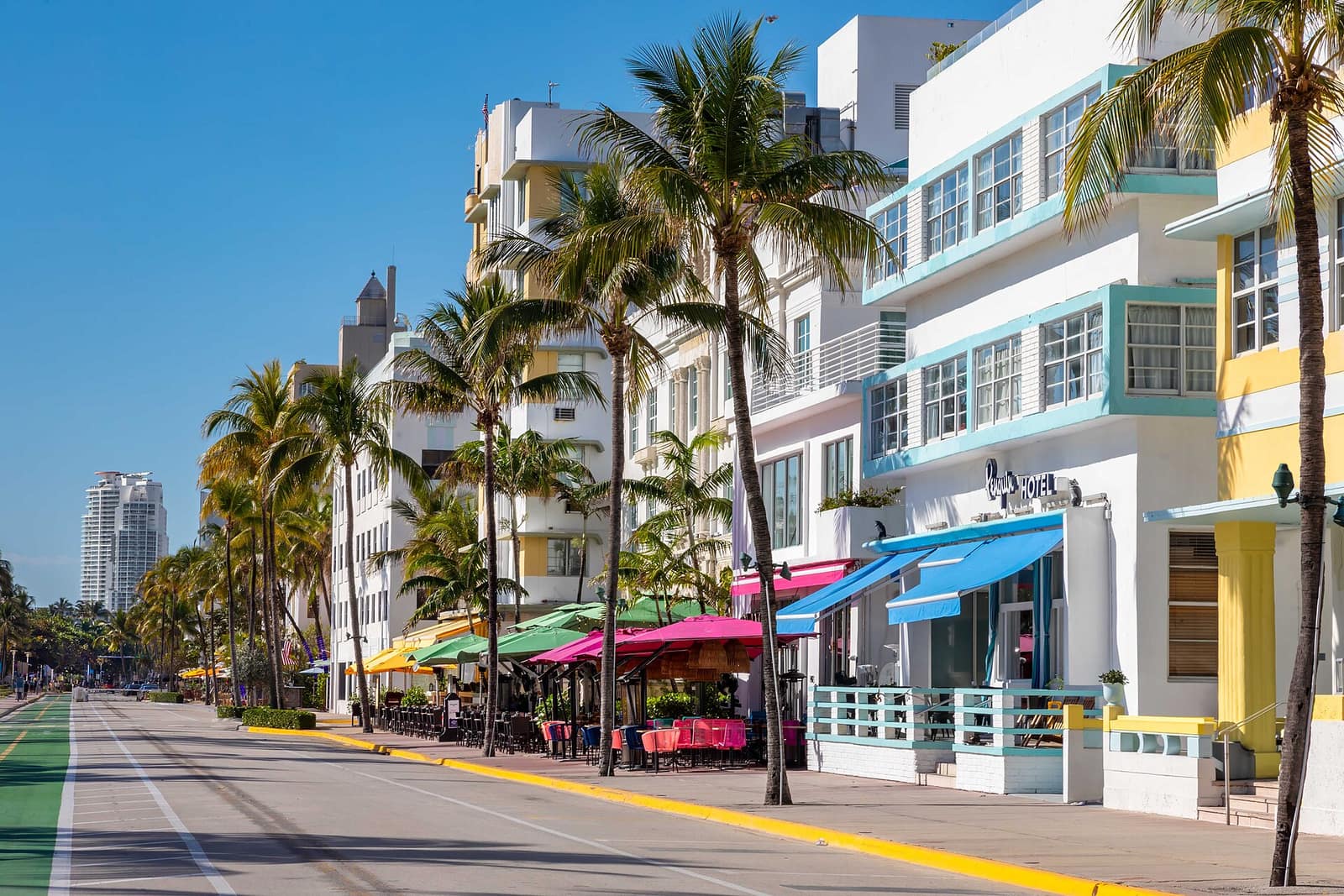
Ocean Drive, the one-block-wide street between Lummus Park and the pastel hotels, is what most visitors picture. The hotels run from the 1920s through the 1940s, built in the Art Deco and Mediterranean Revival styles that give South Beach its look: curved corners, porthole windows, pink and seafoam green and white stucco. Many are still operating hotels and the restaurants and cafes on the ground floor face the park and the beach. For a meal on the drive, expect $20 to $40 per person at lunch. The crowds peak between 11 a.m. and 4 p.m.; evenings when the facades are lit and the street is closed to cars are the most enjoyable time to walk it.
South Pointe Park at the southern tip of Miami Beach has views of the Government Cut channel, container ships passing the inlet, cruise ships heading out toward the Keys, and the downtown Miami skyline across the bay. It is one of the few spots in Miami Beach where you can stand on a lawn and watch both the ocean and the city at once.
Wynwood, Brickell, and the Design District
Wynwood sits about 3 miles north of downtown Miami, roughly between NW 20th and NW 29th Streets on either side of NW 2nd Avenue. The neighborhood is outdoor gallery, restaurant block, and bar corridor all at once. Wynwood Walls, the curated block of large-format murals on NW 2nd Avenue between 25th and 26th Streets, is the anchor: 36 building facades painted by artists from around the world. The Walls themselves charge a small admission to the interior courtyard, but the exterior murals on the surrounding blocks are visible for free. Galleries, coffee shops, and restaurants have taken over most of the surrounding blocks. Go on a weekday if you want to walk without a crowd; weekend evenings in Wynwood can pack the sidewalks.
Brickell, the financial district on the mainland south of downtown, has a different energy: glass towers, the Brickell City Centre shopping complex on SE 8th Street, and a riverfront along the Miami River. The waterfront walk between downtown and the Brickell area is good at any time of day and gives you the city skyline from the water. The Design District, north of Wynwood around NE 38th and 39th Streets, runs toward high-end retail but also has public art installations in the courtyards between shops.
Little Havana
Little Havana lines SW 8th Street (Calle Ocho) west of downtown, about a 10-minute drive or $12 Uber from South Beach. The heart of the neighborhood runs from SW 27th Avenue east toward the Miami River. Maximo Gomez Park at SW 15th Avenue, known locally as Domino Park, is a small open park where older Cuban men play dominoes most mornings. It is free, open to anyone who wants to watch, and one of the more genuine public spaces in the city.
Versailles Restaurant at 3555 SW 8th St is the most famous Cuban restaurant in Miami, an institution that has operated since 1971 and stays packed from breakfast through midnight. The ventanita (walk-up window) on the side serves cafecito (a tiny, intensely sweet espresso shot) and pastelitos for a couple of dollars each. For something less well-known, the surrounding blocks of Calle Ocho have small Cuban lunch counters and bakeries where a full plate of rice, black beans, and roast pork runs under $15.
The Calle Ocho festival each March fills the street for eight blocks and is one of the largest street festivals in the country, but the neighborhood is worth a half-day visit any time of year.
Biscayne National Park and the Bay
Most national parks are reached by long drives into wilderness. Biscayne National Park sits at the edge of the Miami metro, about 30 miles south of downtown via US-1 to Homestead and then east on SW 328th Street. The park is 95 percent water: Biscayne Bay, the northern Florida Keys, living coral reefs, and shipwrecks on the Maritime Heritage Trail. The only way to see the good parts is by boat.
The Dante Fascell Visitor Center at Convoy Point in Homestead is the park’s main hub, and the NPS-authorized boat concession runs glass-bottom boat tours, snorkel trips, and kayak rentals. The snorkel trips go out to the shallow reefs off Elliott Key, where the water is clear and warm and the coral is some of the most intact in South Florida. In calm summer conditions the visibility can be 30 to 40 feet. Book ahead: the tours run on a set schedule and the limited slots fill on weekends and holidays.
If you’re after paddling without a guided trip, the bay around the visitor center is calm enough for a kayak or canoe on most mornings, with mangrove shoreline to explore on the mainland side. The park entrance and visitor center are free; boat tours and equipment rentals are priced by the concession.
A Day Trip to the Everglades
The closest Everglades entrance to Miami is Shark Valley, 40 miles west of downtown on US-41 (the Tamiami Trail), about 45 to 60 minutes in typical traffic. At Shark Valley, a 15-mile paved loop road runs through the sawgrass prairie, and the combination of tram tours and rental bikes makes it the most approachable entrance for a short visit. Alligators are reliably visible on the path year round: the dry season (November through April) concentrates wildlife along the remaining water, but summer mornings also produce good sightings before the heat peaks. Tram tours run several times a day and take about 2 hours; bike rentals let you go at your own pace.
The Ernest F. Coe Visitor Center at the main park entrance in Homestead, about 40 miles south of downtown, is an hour from Miami Beach and pairs well with a Biscayne National Park day. The Anhinga Trail at Royal Palm, a short boardwalk walk from the Coe entrance, puts you within a few feet of herons, anhingas, turtles, and alligators in the winter dry season. No telephoto lens required. For the full Everglades National Park breakdown, including the three separate entrances and what each one offers, see the park guide.
The NPS Everglades site has current conditions, entrance fees, and ranger-led program schedules; the entrance fee is $35 per vehicle and is valid for 7 days across all park entrances.
Private airboat operators line the Tamiami Trail east of the Shark Valley entrance. These are not inside the national park; they run tours on private wetlands south of the highway. The boats are loud and the rides are fast, and a half-hour tour runs around $30 to $45 per person. If you want the airboat experience, this is where to get it.
Getting Around Miami
The Metrorail covers downtown and Brickell on the mainland, and the Metromover loop circles downtown for free. Neither system crosses to Miami Beach. The Miami Beach trolley runs free along Collins Avenue from South Beach through Mid-Beach to North Beach on a regular schedule, and the South Beach local route covers the main stretch from Government Center to South Pointe. For everything else, Uber and Lyft are how most visitors move.
Driving your own car on Miami Beach is possible but slower than it sounds. Parking on Ocean Drive is metered and typically full by 10 a.m. on weekends; the garages on Collins Avenue and behind the streets cost $3 to $6 per hour. If you are staying in a South Beach hotel and your main activities are beach, Wynwood, and Little Havana, car-free works: Uber from South Beach to Wynwood is under $20 and takes 15 to 20 minutes off-peak. A rental car is necessary for day trips to the Everglades and Biscayne, and for getting between Miami and Fort Lauderdale or the Keys efficiently.
When to Go and Where to Stay
Miami’s dry season runs roughly December through April. This is the peak travel window: no daily afternoon storms, low humidity, and temperatures in the upper 70s during the day. It is also the most expensive season, with Ocean Drive hotel rates often running $250 to $500 per night in January and February. Spring break (March and much of April) brings heavy crowds to South Beach. The shoulder months of May and October offer lower prices and smaller crowds, though afternoon storms begin in May and can last through October. Summer runs hot, upper 80s to low 90s, with near-daily thunderstorms from about 3 to 5 p.m. that usually clear by evening. Hotel rates on South Beach drop significantly in summer, and the beach is often less crowded on mornings before the storms arrive.
Where to base yourself depends on your priorities. South Beach hotels put you on the beach and in walking distance of Ocean Drive, but the nightlife and noise on and around Ocean Drive mean most hotels on the strip are loud through midnight or later. Mid-Beach along Collins Avenue from about 25th to 44th Street is quieter and still walkable to the beach. Brickell and downtown Miami have more moderate rates and straightforward highway access for Everglades day trips, but put you 20 minutes by Uber from the sand. Coconut Grove and Coral Gables, south of downtown, are residential neighborhoods with good dining and easier parking if you have a car.
For a full itinerary that takes in Miami, the Everglades, and the upper Keys in sequence, the South Florida and the Everglades route maps out how to spread the days. And for the broader Miami city page, with neighborhood details and logistics, start there before booking.